

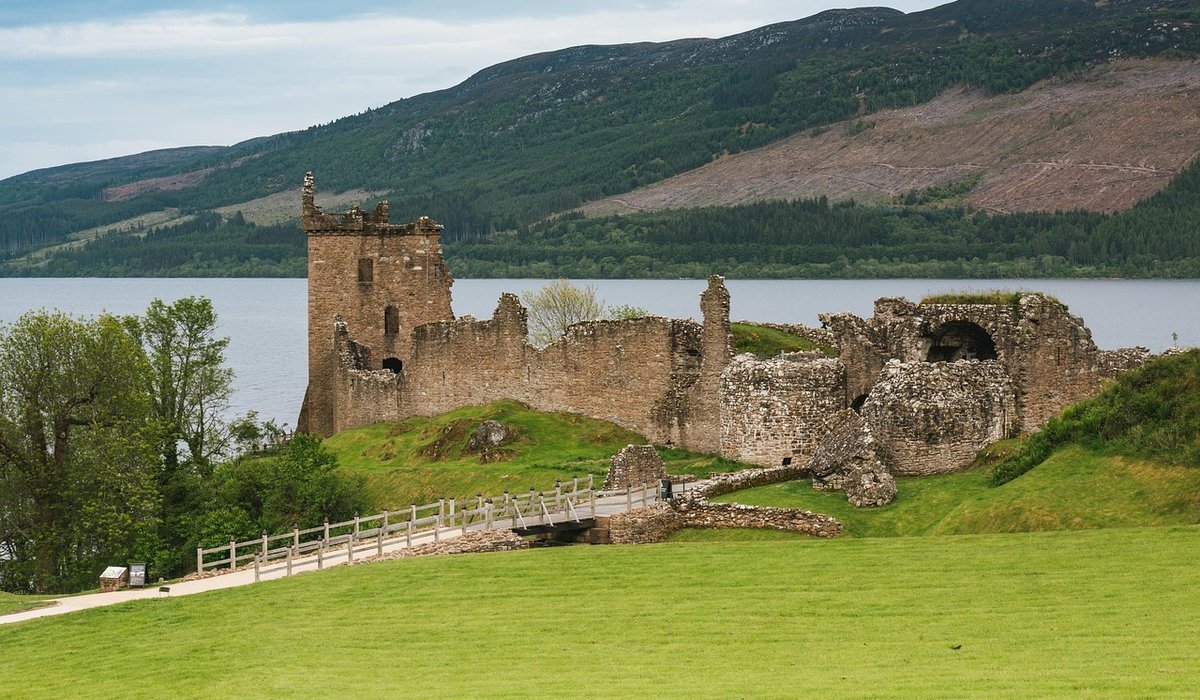
Culloden Battlefield lies on a windswept expanse of heather, gorse and rough grazing about five miles east of Inverness, close to where the A9 meets the B9006. On 16 April 1746, the Jacobite army of Prince Charles Edward Stuart was defeated here by government forces under the Duke of Cumberland. The fighting was over in well under an hour, and as many as 1,500 to 2,000 Jacobites were killed. It remains one of the shortest and bloodiest battles ever fought on British soil.
What matters most when you visit is remembering what this place is: a mass grave. The moor is maintained as a memorial rather than a monument, and a little preparation — starting indoors, walking slowly, keeping your voice down — makes for a far richer day out.
If you arrive cold, the moor itself gives very little away. It undulates gently, the horizon is broken only by a few trees and a low cottage, and without context it can look like nothing more than farmland. So begin at the visitor centre and let the exhibition do the work of setting the scene.
The displays guide you through the politics, the personalities and the year-long campaign that ended here — the rising of 1745, the march south, the retreat, and the decision to stand and fight on ground that suited the government army far better than the Jacobites. Objects on show include weapons, campaign maps, clothing and personal items recovered from the field.
The centrepiece is a 360-degree immersion theatre that places you in the middle of the battle. It is loud, disorienting and deliberately uncomfortable, and it does more than any panel of text to explain how a Highland charge could break apart under artillery and disciplined musket fire. Allow an hour indoors before you go out, and pick up the audio guide if one is available — it is included with admission and worth the small extra time.
Two waymarked routes leave from the centre, and the ground is largely flat, though often soft. The shorter circuit takes in the government lines, the Jacobite front line and the clan graves. The longer route adds the Culwhiniac enclosure, the area where the Jacobite right wing was hemmed in by stone walls, and the Field of the English on the far side of the road.
Interpretation panels along the way explain how the lines were drawn up, where the artillery was placed and why the boggy ground in front of the Jacobite left made a charge almost impossible.
The most affecting part of any visit is the cluster of grave markers on the Jacobite side of the field. These simple stones were erected in the nineteenth century and carry the names of the clans whose men fell here — Fraser, Cameron, Macintosh, Maclean, Stewart of Appin, Chattan, MacGillivray, Munro, Campbell, MacLachlan and MacDonald among them. Visitors leave coins, small stones and flowers on top of them, and the effect is quietly powerful.
Nearby you will find the large memorial cairn, raised in 1881, and the small thatched Leanach Cottage, which stood on the field at the time of the battle and later served as a farm building. Look out too for the Well of the Dead and Keppoch's Stone, each with its own story attached.
Treat these places as you would any graveyard. Stay on the paths where they are marked, keep dogs on a short lead, leave nothing behind, and avoid drones altogether — the site sits within a protected landscape and the noise is intrusive.
Culloden sits within a landscape rich in older history. A short drive away, the Bronze Age burial cairns at Clava Cairns are well worth an hour, and the surrounding farmland and woodland make for gentle walking. Back in Inverness, the river, the cathedral and the museum collections round off the story nicely.
Come with time to spare, come dressed for the weather, and come ready to listen rather than simply to look. Culloden rewards those who give it quiet attention.

Strathisla Inverness Simple, genuine and looked after with care — the kind of place worth returning to.

Strathisla Inverness Real stories, useful guides and the occasional recommendation, all in one calm corner of the web.

Find traditional sessions, intimate gigs, and friendly pubs where local musicians share Highland tunes throughout the week and weekend.

Comments
ALina Kelian
19th May 2018 ReplyStrathisla Inverness No rushing, no fuss — just thoughtful notes and practical help, written by people who care. ullamco laboris nisi ut aliquip ex ea commodo consequat.
Rlex Kelian
19th May 2018 ReplyStrathisla Inverness An honest, everyday look at the things that make life a little better — with advice you can actually use. ullamco laboris nisi ut aliquip commodo.
Roboto Alex
21th May 2018 ReplyStrathisla Inverness No rushing, no fuss — just thoughtful notes and practical help, written by people who care. ullamco laboris nisi ut aliquip ex ea commodo consequat.